Cloister Meaning: Definition, History & Essence
What Is a Cloister?
A cloister is both a sacred space and an architectural feature. In its noun form, it refers to:
- An enclosed monastic complex, such as a monastery or convent—essentially a space of spiritual retreat.
- Architecturally, it’s a covered passage or open gallery—often arched—that frames a quadrangle or courtyard (garth).
As a verb, to cloister means to seclude or confine (figuratively or literally), akin to placing someone “within walls.”
Why Is It Called a Cloister?
The term comes from:
- Latin claustrum, meaning “enclosure” (literal), from claudere, meaning “to close.”
- Transitioned through Old French cloistre, and entered Middle English as “a monastery or covered walkway.”
The name reflects the idea of separation, enclosure, and spiritual seclusion.
Architecture & Monastic Life
Cloisters evolved from ancient traditions like the Roman peristyle—a columned courtyard—and Christian atriums.
By the medieval era, the cloister became the core of monastic life. Layouts varied:
- Benedictine style: Church on one side, refectory opposite; dormitory, chapter house, and guest lodgings arranged around the other wings.
- Cistercian style: Similar setup but with lay brothers housed on the west, workshops underneath, dormitories above.
A cloister wasn’t just a passage—it was the multi-purpose hub, used for meditation, reading, teaching novices, burials, and processions.
Design, History & Evolution
- Earliest European cloisters appeared around the 8th–9th centuries, with triangular or square layouts in places like Lorsch Abbey and Saint Gall, evolving into the classic quadrangle.
- They physically and symbolically separated monks from the secular world, forming a “monastery within a monastery.”
- Cloister spaces still influence modern campuses and historic sites like Manhattan’s The Cloisters museum (1930s), evoking medieval architecture.
Cloister Gardens: The Garth
Often a courtyard surrounded by the cloister walkways, these spaces are known as cloister gardens or garths.
- Historically, these gardens served practical and spiritual purposes—gardens for herbs, medicine, and contemplation.
- Yet, monastic records suggest that cloisters were largely devoid of plants, focusing instead on quiet study and reflection, sometimes with a well at its center.
Phonetics & Usage
- Pronunciation: /ˈklɔɪstər/ (“KLOY-stər” or “CLOI-ster”)
- As Slang: Rare. Occasionally used to evoke isolation or retreat, like “book lovers cloistered in their own bibliophilic worlds.”
Synonyms:
- Enclosure, monastery, retreat, arcade, quadrangle, seclusion.
Antonyms:
- Exposure, openness, public square, secular world.
Cloister in Music: Vinyl, CDs & Beyond
There isn’t mainstream or widely recognized music under the name “Cloister” in popular retail catalogs.
Famous Cloisters Around the World
1. The Cloisters – New York City
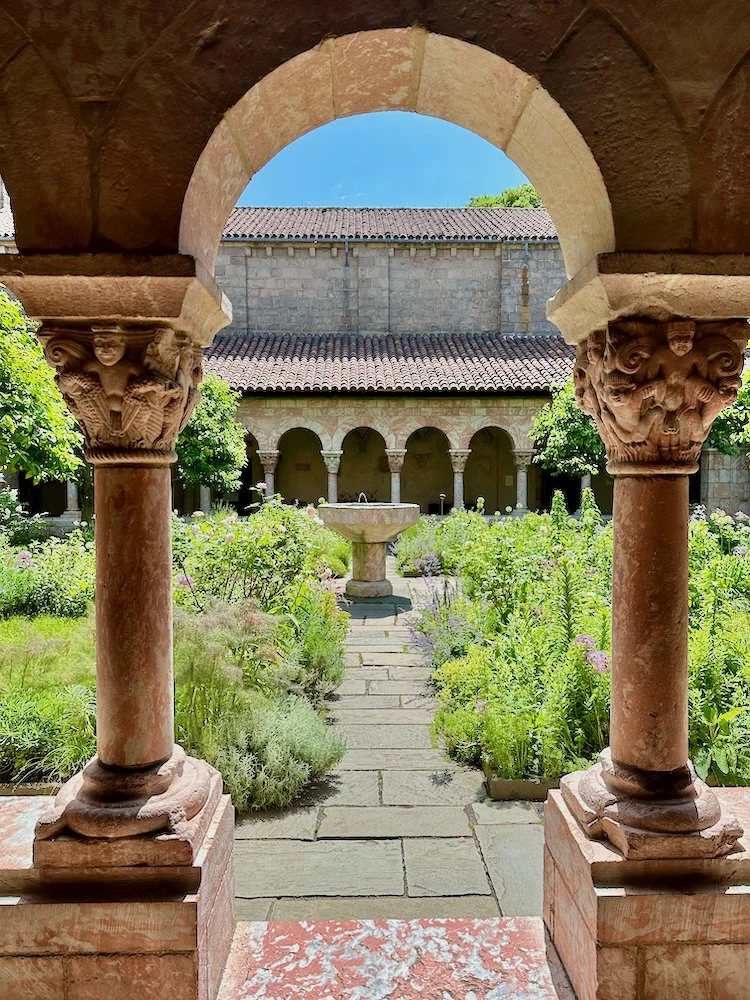
Part of the Metropolitan Museum of Art, this atmospheric museum was built by reassembling sections from four medieval cloisters—the Cuxa, Saint-Guilhem, Bonnefont, and Trie-sur-Baïse—with Byzantine and Gothic art set within authentic architectural fragments. Designed to evoke medieval spirituality, it opened in the 1930s thanks to John D. Rockefeller Jr.’s patronage.
2. Italian Monastic Cloisters
- Ferrara, San Romano Church: Features 10th-century arcades with ornate capitals—an excellent surviving example of early medieval cloister design.
- Bologna, San Domenico Basilica: An 11th-century Gothic-Romanesque cloister built around delicate Corinthian-columned arcades.
- Bologna, Santo Stefano (Two-Story Cloister): Combines robust low-level Romanesque arches with lighter, sculpturally rich upper-level Gothic arcades—possibly an inspiration to Dante’s literary imagery.
3. Abbey of Santo Domingo de Silos (Spain)
One of the most celebrated Romanesque cloisters, barely altered since its 11th-12th-century construction. It features semi-circular arcaded galleries with capitals carved in vivid biblical and mythological scenes.
4. Certosa di Pavia (Italy)
Named for its Small and Grand Cloisters: The former houses a terracotta-decorated portico and fresco fragments; the latter opens into a large garden, surrounded by arcades with terracotta and marble decoration depicting saints and angels.
5. Cloisters of Sant’Ambrogio (Milan)
Designed by Bramante (1497), these cloisters feature high Doric and Ionic arcades, later repurposed as part of a university complex, blending Renaissance architecture with modern utility.
Modern Cloisters & Contemporary Interpretations
- “A Wall for a House” (UK): A modern reimagining of the cloister typology in a suburban home by Takero Shimazaki Architects. It uses a glazed loggia to fluidly connect indoor living spaces with an outdoor garden, blurring boundaries like the medieval cloister.
Cloister Gardens & Their Legacy
Monastic cloisters often included garths (courtyard gardens) for contemplation and utility—herbs, medicinal plants, and quiet reflection. At The Cloisters (NYC), three gardens (Cuxa, Bonnefont, Trie) are planted using medieval horticultural sources, creating evocative period gardens within museum spaces.