What Is Morse Code?
Picture a world where pulses of sound carry entire messages. That’s what “Morse Code” is—a clever communication system translating letters, numbers, and punctuation into sequences of dots and dashes via electrical or visual signals.
Definition
Morse Code is a telecommunications method that encodes text characters into standard patterns of dots (dits) and dashes (dahs), with spaces shaping clarity. It serves as a binary-like signaling system ideally suited for noisy or low-bandwidth channels.
Word Breakdown
Let’s unpack key elements:
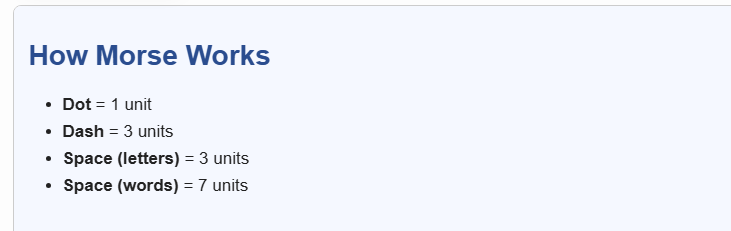
- Dots (dits): Brief signals.
- Dashes (dahs): Three times longer than a dot.
- Intra-character gaps: One-dot length; between letters: three dots; between words: seven dots.
Meaning and Significance
At its core, this code is about efficient encoding—the most frequent letters have the shortest patterns. It powers concise messaging, pumping data over wires, lights, or radio waves in a highly resilient, human-decipherable format.
Usage in Context
You’ll see Morse Code used in various contexts. Pilots rely on it to identify navigational beacons. Amateur radio operators (“hams”) transmit messages with it. Even in emergencies, the SOS signal—three dots, three dashes, three dots—remains globally recognized.
Comparison
American Morse Code (aka Railroad Morse) was the original U.S. version. It offered faster sending rates but had uneven dashes and spacing that led to errors. In contrast, International Morse Code, standardized in 1851, uses constant timing and is simpler, much more reliable—hence its global adoption.
Etymology
Named after Samuel F. B. Morse, who devised a telegraph system in the 1830s. The term “Morse Code” gained traction by the 1860s as his system became widely recognized.
What’s Included in morse code?
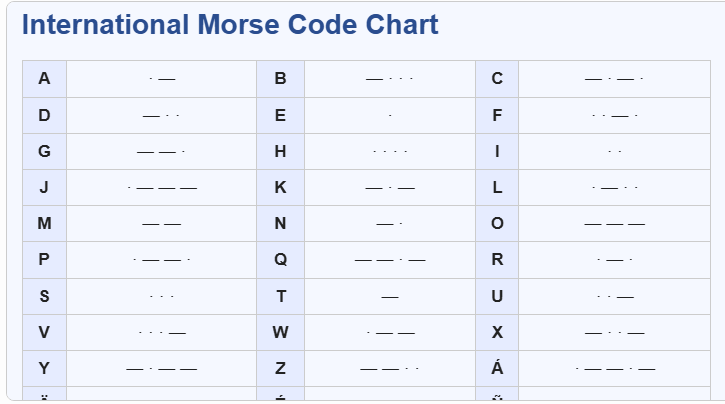
International Morse Code covers:
- The 26 basic Latin letters
- Digits 0–9
- Punctuation marks and prosigns (e.g., SOS)
It supports signals across text, light, audio, and radio forms.
Also read: Morse Code Translator
Related Terms
Familiar words include:
- Telegraph key: the manual device for sending signals
- Heliograph / Aldis lamp: light-based transmitters
- Continuous Wave (CW): mode in amateur radio
- Farnsworth Method / Koch Method: training techniques for learning code efficiently
Synonyms
People may refer to Morse Code simply as:
- International Morse code
- Code signals
- Telegraph code
Who invented Morse Code?
Samuel F. B. Morse, an American painter-turned-inventor, developed the earliest version of Morse Code in the 1830s for use with his electric telegraph system. His collaborator Alfred Lewis Vail refined the system in 1840—assigning dot-dash patterns to letters and inventing essential hardware—making the code practical and widely usable.
| Question | Snippet-Optimized Answer |
|---|---|
| Who invented Morse Code? | Samuel F. B. Morse invented the original system; Alfred Vail refined it into the dot-dash code. |
| Why is Alfred Vail important? | He developed the actual dot-dash alphabet and key equipment that made Morse Code practical. |
| What was Morse’s contribution? | He conceived the concept and patented the telegraph and signaling method. |
| When was Morse Code patented? | It was patented by Morse in the U.S. on June 20, 1840. |
| Is Morse Code still in use? | Yes—the International version is still used by radio operators, aviators, and in some emergency systems. |
FAQs
What is Morse Code?
A system using dots and dashes to encode characters for transmission via sound, light, or electrical signals.
Is Morse Code still used?
Yes. It’s still used by amateur radio operators, aviators for beacon IDs, and in certain niche or emergency scenarios.
How does the SOS distress call work?
It’s the prosign “…—…”—three dots, three dashes, three dots—first adopted by Germany in 1905, standardized internationally by 1908.
Final Thoughts
Morse Code is a timeless, resilient mechanism that we still use today in subtle but meaningful ways. Its rhythmic pulses taught the world to communicate faster, whether through sound, light, or radio waves. Amid our digital era, it’s a reminder that simplicity often wins.